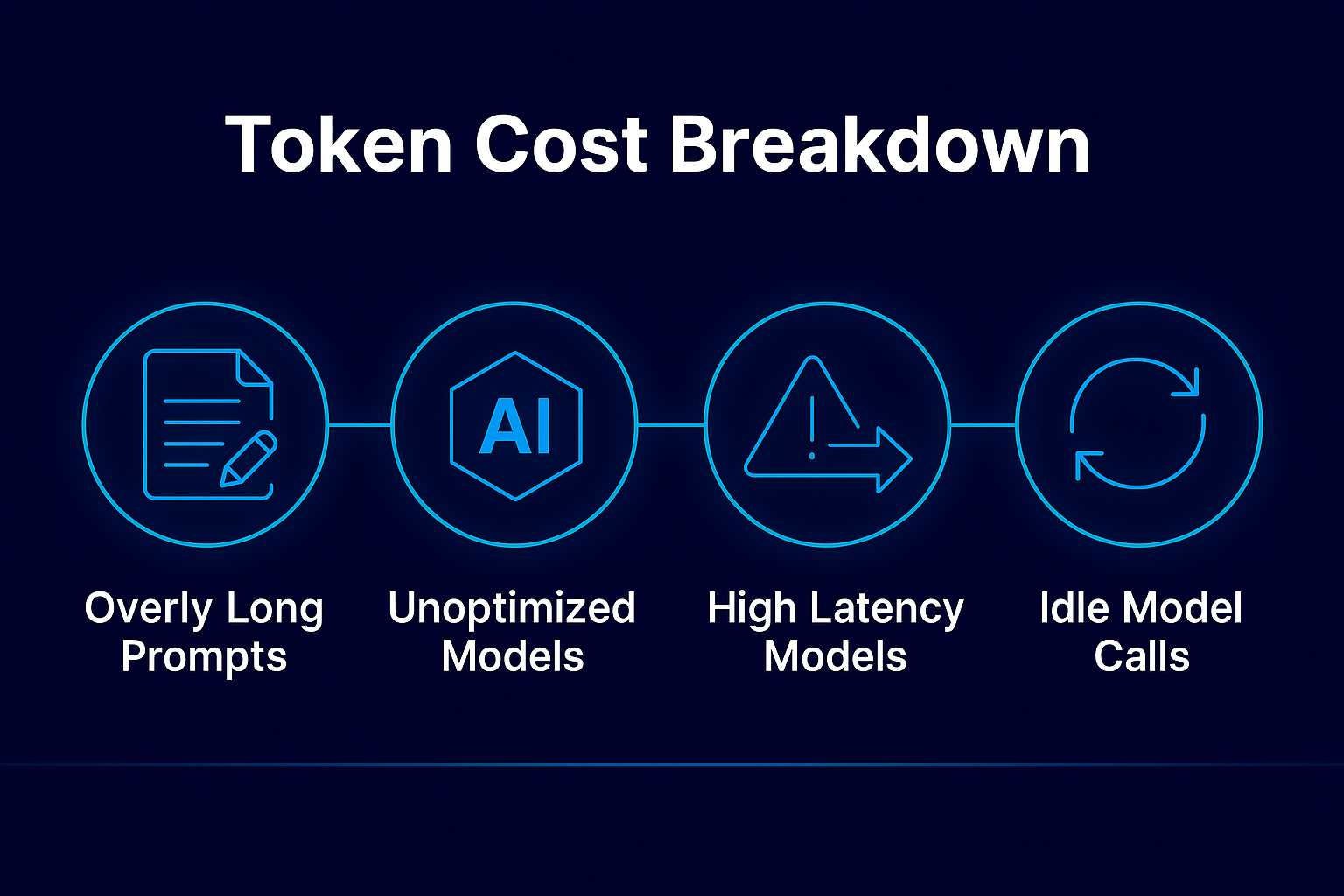

Large Language Models (LLMs) are powerful — but expensive. For CFOs and Heads of Data Science, the growing token spend is becoming a silent budget killer. While teams rush to prototype and deploy AI services, they often overlook the fact that each API call, each prompt, and each poorly managed routing decision can lead to exponential token costs.
In this article, we break down where token waste comes from, why organizations lose control of LLM budgets, and how to achieve true LLM cost optimization through smart strategies such as dynamic routing, observability, and LLM gateways.
Where this stands in August 2026
This article was first published in December 2025. Eight months on, the mechanics of token waste have not changed, but three things about the problem have.
First, per-token list prices kept falling while total bills kept rising. Cheaper tokens invite more calls, longer contexts and more agents, so finance teams expecting relief from price cuts have not seen it. Volume, not unit price, now drives the invoice.
Second, the spread between model tiers stayed wide. The gap between a frontier model and a small model is still often two orders of magnitude per token, which is why smart routing remains the single most effective lever. Customers regularly cut spend by up to 90% on routable workloads.
Third, agents changed the shape of the bill. One agentic workflow can trigger dozens of model and tool calls per user request, so cost tracking per team and use case, backed by real-time monitoring, has moved from nice-to-have to baseline. If you cannot see which workflow is burning tokens, you cannot fix it.
The guidance below holds up. Where model names have aged, read them as whatever sits in the frontier and budget tiers today.
The Hidden Cost of Tokens
Tokens are the "currency" of LLMs, and every input and output counts. For AI leaders, this means that token inefficiencies quickly snowball into six- or seven-figure expenses.
Main cost drivers:
- Overly long prompts: Unoptimized prompt design inflates input tokens unnecessarily.
- Excessive context windows: Feeding full documents instead of chunked/relevant snippets drives waste.
- Model overkill: Using a frontier model like GPT-4o or Claude Opus for simple classification tasks when a smaller model suffices.
- Lack of monitoring: No clear visibility into which departments, teams, or applications are consuming tokens.
- Redundant calls: Running multiple model queries without caching or orchestration.
For CFOs, these inefficiencies are invisible in financial dashboards until the invoice arrives.
Why CFOs and Data Science Leaders Struggle
Despite their technical expertise, many organizations fail to implement governance and cost controls around LLM usage.
- Siloed AI experiments: Different teams spin up models independently, with no central oversight.
- No cost attribution: Finance teams can't tie token spend back to business units or projects.
- Unclear ROI: Leadership struggles to measure whether token spend translates into tangible business outcomes.
- Vendor lock-in: Depending on a single LLM provider leads to high costs and no flexibility.
For CFOs, the question becomes: Are we burning money without measurable value?
How Token Spend Spirals Out of Control
Let's break it down with a realistic scenario:
- A support chatbot queries a frontier model for 500k requests/month.
- Average prompt + response = 1,500 tokens.
- Token cost = ~$0.03 per request.
That's $15,000/month for a single chatbot — and this doesn't include scaling across multiple departments. Multiply that by marketing content, R&D, document analysis, and internal tools, and you see why token bills skyrocket.
LLM Cost Optimization: The Key Levers
To stop burning money, organizations need structured cost optimization practices.
Prompt Engineering Discipline
- Cut unnecessary tokens with concise prompts.
- Apply embeddings and retrieval (RAG) to reduce context length.
- Standardize prompt templates across teams.
Model Right-Sizing
- Route simple tasks (summarization, classification) to smaller, cheaper models.
- Reserve frontier models such as GPT-4o or Claude Opus for complex reasoning.
- Use open-source LLMs for repetitive workloads when feasible.
Observability and Reporting
- Track token usage per team, project, and application.
- Benchmark cost per business outcome, not just per API call.
- Provide finance dashboards that translate token spend into budget language.
Dynamic Routing with an LLM Gateway
This is where LLM gateways come in. Instead of coding model selection logic into every app, a gateway centralizes routing decisions.
- Automatically routes requests to the most cost-efficient model.
- Provides policy enforcement (e.g., cap frontier-model calls at 20% of workload).
- Offers real-time observability into token spend.
- Enables CFOs to set budget limits and track compliance.
With an LLM Gateway, organizations can cut token spend by 30-50% without sacrificing performance.
Run Your Own Numbers
Model your own traffic mix with our token-cost calculator. Enter your monthly request volume and model split, and see what routing and right-sizing would save before you change anything in production.
Token Spend Benchmarks for CFOs
When evaluating cost efficiency, CFOs and Data Science leads should measure:
- Cost per request: How much do we pay per API call?
- Cost per outcome: What's the business value vs. token expense?
- Model utilization ratio: % of requests handled by high-cost vs low-cost models.
- Scaling efficiency: Do costs rise linearly or exponentially with usage?
These benchmarks allow finance teams to move from reactive invoice management to proactive cost optimization.
Case Study: Cutting Token Costs with a Gateway
A global telecom enterprise adopted an LLM gateway to unify their AI initiatives:
- Before: GPT-4 everywhere, $200k/month in token costs, no observability.
- After: Introduced dynamic routing with smaller models for 60% of tasks.
- Results: 42% cost reduction, full compliance reporting, and CFO dashboards mapping token spend to projects.
The lesson? Cost savings come not from cutting AI usage, but from intelligent orchestration.
Governance and Compliance Angle
Beyond financial optimization, token management ties directly to AI governance.
- Audit logs: Trace every LLM call for compliance reviews.
- Guardrails: Ensure sensitive data doesn't flow into external APIs unnecessarily.
- Budget policies: Enforce spending caps across teams.
For regulated industries (finance, healthcare, telco), governance is as important as cost savings.
Buy vs Build: Why Gateways Matter
Some CTOs consider building internal solutions for routing and observability. However:
- Time to market: Building cost dashboards + routing logic can take 6-12 months.
- Hidden costs: Engineering maintenance, monitoring pipelines, compliance overhead.
- Vendor support: Ready-made gateways evolve faster and include enterprise features.
For CFOs and Heads of Data Science, the buy vs build analysis often tilts heavily towards ready-made gateways. If you are weighing that trade-off, Kosmoy pricing shows what a ready-made platform costs against a 6-12 month internal build.
Conclusion
Token spend is no longer an invisible line item — it's a strategic cost center that CFOs and AI leaders must actively manage. Without control, enterprises risk ballooning AI bills and little ROI.
By focusing on prompt discipline, model right-sizing, observability, and dynamic routing via an LLM Gateway, organizations can optimize LLM costs by up to 50% while maintaining governance and scalability.
If your AI budget feels like it's burning tokens without results, now is the time to put LLM cost optimization at the center of your AI strategy.
Frequently asked questions
How do you reduce LLM token costs without cutting usage?
Route each request to the cheapest model that handles it well. Combine concise prompts, retrieval instead of full-document context, caching for repeated queries, and per-team cost attribution. Most savings come from routing, because most enterprise queries do not need a frontier model.
How much can an LLM gateway cut token spend?
Up to 90% on routable workloads, because the price gap between a frontier model and a small model is often two orders of magnitude. Typical blended savings are lower: this article outlines a 30-50% reduction across a mixed enterprise workload once routing, caching and observability are in place.
Why are our LLM API bills so high?
Usually five compounding causes: overly long prompts, full documents pasted into context windows, frontier models used for simple tasks, redundant calls with no caching, and no per-team attribution, so nobody owns the number. None of these show up in finance dashboards until the invoice arrives, which is why visibility is the first fix.
Should we build our own LLM cost controls or buy a gateway?
Buy, in most cases. Building routing, dashboards and policy enforcement in-house typically takes 6-12 months and then needs permanent maintenance, while a ready-made gateway ships those controls on day one. Building makes sense only when routing logic is itself your product or your constraints rule every vendor out.